
Filter articles
PAT Tuhituhi: The writing tool supporting hundreds of NZ schools
29 May 2026, 9:17 AMHow NZCER partnered with Catalyst to build the platform foundation that enabled reliable, standardised writing assessments to New Zealand schools - and made automated marking possible.
Background
Rangahau Mātauranga o Aotearoa | New Zealand Council for Educational Research (NZCER) has been New Zealand's independent provider of educational research, assessments and advice since 1934. Its Progressive Achievement Tests (PATs) are used by more than two-thirds of schools across New Zealand and help provide kaiako (teachers) with reliable, curriculum-aligned information on how ākonga (students) are progressing in pāngarau (maths) and pānui (reading). Before 2025, there wasn’t an equivalent for tuhituhi (writing).
In primary and intermediate schools, writing can be a difficult subject to assess consistently. Unlike maths or reading, writing is subjective - a teacher reads each response, weighs it against a rubric, and applies their judgement. For kaiako, that means time and consistency are a challenge. For ākonga, it can mean waiting longer for feedback while learning is fresh in their minds. And for schools, because judgment varies from teacher to teacher, the results are difficult to standardise or compare across year groups. This meant schools did not have a like-for-like picture of how students were progressing in writing.
Opportunity
NZCER and the Educational Assessment Research Unit from the University of Otago deliver assessments as part of the national Curriculum Insights and Progress Study. In 2023, NZCER identified the chance to do something that hadn't been done before in New Zealand: build a standardised, reliable writing test that could work at scale. NZCER had the research expertise, the curriculum knowledge, and the relationships with schools, and a longstanding relationship with Vantage Labs, who have decades of experience in developing and supporting writing scoring solutions. What they needed was a technical foundation that could grow with them so they could deliver the test for the study and expand it in the future.
To integrate Vantage Labs scoring solutions with NZCER Assist, NZCER turned to Catalyst. The two organisations had worked together since 2013, and Catalyst had built and maintained the open source platform underpinning the PATs. That shared history across the architecture meant NZCER could build on the same open source frameworks as existing PATs.

Catalyst’s investment in the platform to support research and product development has enabled NZCER to move swiftly to develop what's needed.
Solution
Catalyst built the functionality for the writing test so it could scale and adapt to schools’ needs. If NZCER wanted to offer more test types down the track, the foundations would already be in place. Six months later, that decision proved its value. The government announced that twice-yearly writing assessments would be mandatory for all students in Years 3–8. Every teacher in the country would need to provide online standardised assessments. And it needed to be ready by term one in 2026. Because the foundations were already in place, NZCER could move quickly.
Building for the long term
The goal for building a writing assessment was to deliver something that felt familiar to teachers already using PATs, worked reliably from day one, and enabled NZCER to choose where it would grow. That meant connecting NZCER's assessment portal with NZCER Assist (the platform schools use to manage assessments and access reporting), so teachers had the same experience. Writing results and reporting tools sit on the same framework used across all PATs, so kaiako can access students’ reading, writing, and maths results in the same place.
For the youngest students, there was an additional challenge. Year 3 and 4 students aren't always confident and proficient with typing and online assessment. This has led to the development of a paper-based option with a new rubric for younger writers. Teachers scan and upload handwritten responses for (manual) marking in NZCER Assist. When this option is released (late term 2, 2026), schools will have a suite of writing assessment options across Years 3 – 10. NZCER and Catalyst are working towards supporting the autoscoring of uploaded handwritten responses and offering paper-based options for Years 5-10.
We value the speed with which we need to move and the fact that we're doing all of these things in parallel.
Leveraging strong foundations for automated marking

NZCER led the automated marking development in partnership with Vantage Labs, making use of Vantage's IntelliMetric® essay scoring, writing tasks and rubrics. It was essential that the tasks, rubrics, and associated scoring models were calibrated against New Zealand student writing.

Those responses then helped to train the providers' models specifically on New Zealand students' language and writing patterns. Training continued until the AI could consistently mark to the same standard as an expert human marker.
Kaiako can accept, adjust, or reject any autoscored mark, and a qualitative human review remains in place.
Results
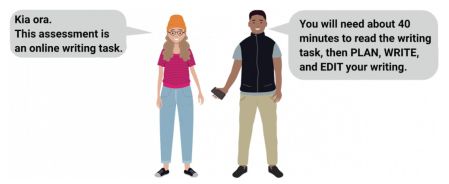

PAT Tuhituhi went live in Term 3, 2025, ahead of the government's deadline. By the end of that year, more than 51,000 assessments had been completed across New Zealand.
In 2026, that number keeps climbing:
- Over 71,000 assessments completed in Term 1, 2026.
- In May 2026, 644 schools had already signed up to use PAT Tuhituhi
- Over 120,000 assessments completed.
For kaiako, autoscored results and reporting arrive quickly for review. This supports kaiako providing feedback to ākonga while their work is still fresh. And for the first time, all of this rich assessment information sits in NZCER Assist, alongside information on reading, maths, listening and more.
The Ministry of Education has also adapted NZCER's rubrics for PAT Tuhituhi for use in its SMART writing tool. This ensures the language used to describe student progress remains consistent across the test type.
Catalyst helps ensure that NZCER's world-class assessments are delivered in a way that keeps pace with technological advancement in the classroom.
What's next
Alongside the Year 3 and 4 trial, NZCER and Catalyst are developing additional reporting options. These include year-group and class reports, school-wide reporting with ethnicity, scale-level, and gender filters, and whānau reports showing where a student's writing sits within the new progress descriptors.
In parallel, Catalyst is supporting NZCER in exploring the possibility of building and hosting its own scoring model on New Zealand infrastructure. This will support kaiako to create their own writing tasks for ākonga as a separate product to PAT Tuhituhi. This work is underpinned by NZCER's commitment to understanding what responsible, locally-governed AI could look like for schools in Aotearoa. We are proud to support them through this thinking.
If you're thinking about what open source technology and collaboration could mean for your organisation, send us a message.
More stories like this

Getting the big moments right: A spotlight on digital government support for life events
For over a decade, the Department of Internal Affairs has led cross government collaboration to shape digital services around the moments that matter most to New Zealand citizens.

A year after the launch of Ia: the world's first Rainbow research portal
Ia, the world’s first Rainbow portal launched in September 2023, and a year on, we share the collaborative nature of the project between Rōpū kohinga and AUT.